QuantaPhi Learn · selected overview
Atomic number, mass number and isotopes
What is atomic number? Atomic number, written Z, is the number of protons in an atom’s nucleus. It identifies the chemical element. [1]
Compare the quantities
| Question | Quantity | Example |
|---|---|---|
| Which element? | Atomic number: protons | Hydrogen has Z = 1 |
| Which isotope? | Mass number A: protons + neutrons | Hydrogen-2 has A = 2 |
| How many neutrons? | A − Z | 2 − 1 = 1 neutron |
| Is it charged? | Compare protons with electrons | Unequal counts give a net charge |
Same element, different isotope
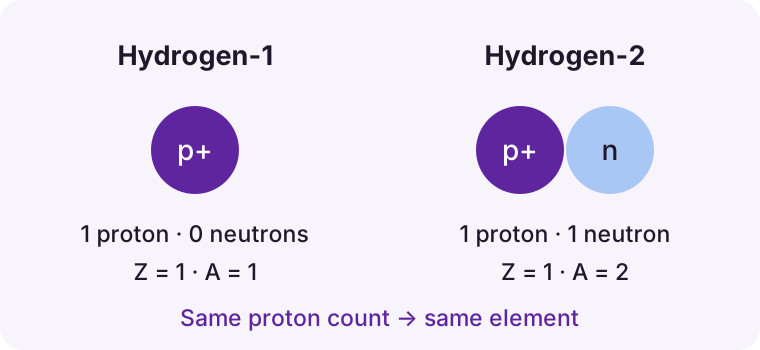
Hydrogen-1 has one proton and no neutrons. Hydrogen-2, also called deuterium, has one proton and one neutron. They share an atomic number, so both are hydrogen; their mass numbers differ. [2]
For an isotope written with mass number A and atomic number Z, calculate the neutron count as N = A − Z. IUPAC defines mass number as the total number of protons and neutrons in the nucleus. [3]
Worked example: ruthenium-102
The element card gives Z = 44. The isotope name gives A = 102. Therefore N = 102 − 44 = 58. Visit the ruthenium lesson to see why a periodic table’s decimal relative atomic mass is a different quantity.
Three changes, three meanings
Add or remove an electron and the charge changes. Change the neutron count and the isotope changes. Change the proton count and the element changes. When reading a scientific claim, first ask which of these counts actually changed.
Practice: hydrogen-3 has Z = 1 and A = 3. How many neutrons?
3 − 1 = 2 neutrons. It is still hydrogen because the proton count remains one.
Use this distinction in a research trail
A search for “atomic number” can lead to an extracted term such as “isotope.” Searching that term creates a linked Quant with its own evidence. The earlier definition remains available as context, so the new record does not have to treat every number as interchangeable.
Sources and what they support
- IUPAC Gold Book: Atomic number — Definition of proton count.
- US Department of Energy: Deuterium–tritium fusion fuel — Proton and neutron counts of hydrogen isotopes.
- IUPAC Gold Book: Mass number — Definition of protons plus neutrons.